

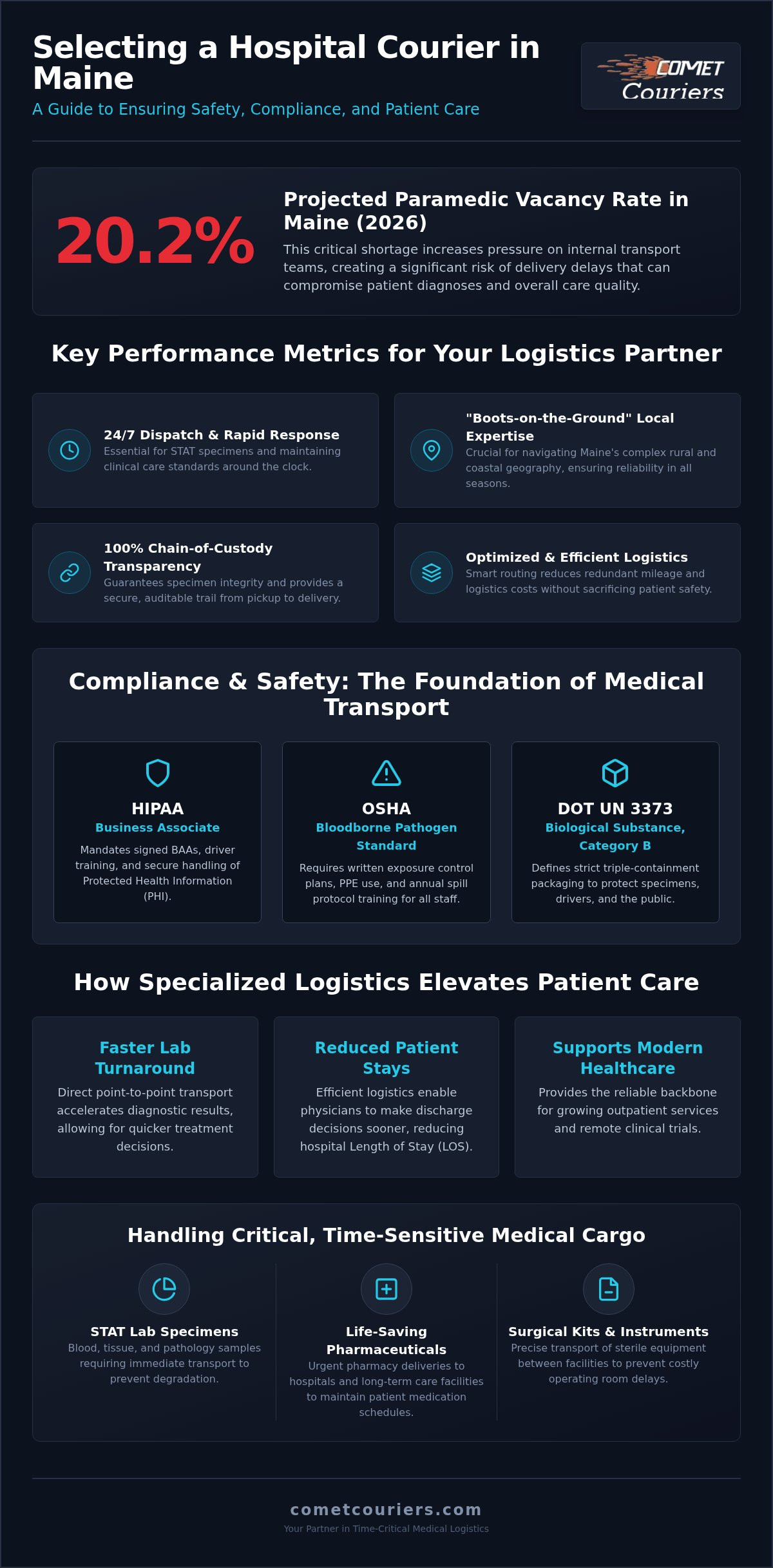
With Maine hospitals reporting a 20.2% vacancy rate for paramedics in 2026, the pressure on internal transport teams has reached a critical point. When your staff is stretched thin, the last thing you need is a delivery delay that compromises a patient’s diagnosis. You know that in our state’s rural landscape, a courier isn’t just a driver. They’re a vital extension of your clinical care team.
Finding a reliable hospital courier service Maine healthcare facilities can depend on requires more than just a van and a GPS. You need a partner who understands the high stakes of specimen integrity and the strict requirements of 2026 MaineCare reimbursement rates. It’s about ensuring that every sample stays within the required temperature range while moving through the complex geography of the North Woods or the Midcoast.
This guide will help you select a logistics partner that ensures 100% chain-of-custody transparency and faster lab turnaround times. We’ll examine essential 2026 compliance standards, including DOT UN 3373 packaging and HIPAA protocols for PHI. You’ll learn how to reduce logistics costs through smarter routing without ever sacrificing the safety of the patients who depend on your results.
Key Logistics Strategies for Maine Healthcare Facilities
- Learn how updated 2026 HIPAA and OSHA standards ensure specimen integrity and data protection during every mile of transport.
- Identify the critical performance metrics procurement officers need to evaluate a hospital courier service Maine providers trust for on-demand and scheduled routes.
- Discover strategies to optimize pharmacy and lab logistics to reduce redundant mileage and accelerate diagnostic results for patients.
- Understand the impact of 24/7 dispatch and rapid response times on maintaining clinical care standards in both coastal and rural Maine facilities.
- Explore why local, “boots-on-the-ground” expertise is essential for navigating the logistical complexities of the Maine interior.
The Critical Role of Hospital Courier Services in Maine’s Healthcare Infrastructure
Hospital couriers provide specialized, time-critical transport for medical items that traditional mail cannot handle. This specialized field of Medical logistics is the backbone of our state’s healthcare system. It ensures that critical supplies move between facilities without the delays inherent in standard parcel networks. Delivery speed directly correlates to diagnostic turnaround times. When a lab result is delayed, patient treatment is delayed. In a clinical setting, every minute saved during transport is a minute gained for patient recovery.
Maine’s unique geography makes this work particularly challenging. Bridging the gap between Portland’s medical hubs and rural clinics in Aroostook or Washington counties requires more than a basic delivery route. It requires a deep understanding of regional transit times and seasonal weather impacts. A reliable hospital courier service Maine providers trust knows how to navigate these long distances while maintaining strict specimen stability. Without this local expertise, rural facilities risk becoming isolated from the advanced diagnostic resources available in larger cities.
Standard delivery services often fail in a medical context. Parcel carriers focus on volume and hub-based sorting. This adds unnecessary touchpoints and increases the risk of loss or damage. A dedicated medical courier Maine specialist offers point-to-point transport. They provide a secure chain of custody that a general carrier cannot match. This difference is critical for maintaining regulatory compliance and ensuring that sensitive samples arrive in viable condition.
Types of Time-Sensitive Medical Cargo
Medical transport covers a wide range of specialized materials. STAT lab specimens, including blood, tissue, and pathology samples, require immediate processing. Any delay can lead to specimen degradation. Life-saving pharmaceuticals also demand high-priority handling. We manage the urgent pharmacy delivery courier Maine needs for hospitals and long-term care facilities to ensure patients receive medication on schedule. Additionally, surgical kits and sterile instruments must be moved between sites with precision. This keeps operating rooms running and prevents costly surgical delays.
The Shift Toward Value-Based Care Logistics
Efficient logistics directly reduce the length of stay (LOS) in Maine hospitals. Faster transport of diagnostic tests allows physicians to make discharge decisions sooner. This efficiency supports the growing trend of outpatient services and home-based clinical trials. Logistical clinical integration is the strategic synchronization of transport schedules with clinical workflows to ensure that patient care remains uninterrupted. As the global healthcare logistics market grows to a projected $145.4 billion in 2026, the focus remains on these localized, high-efficiency solutions.
Compliance and Safety Standards for Maine Medical and Pharmacy Transport
Healthcare providers carry the ultimate legal liability for safety incidents that occur during transit. Compliance is a baseline requirement. It isn’t a premium feature. A professional hospital courier service Maine facilities rely on must operate as a HIPAA business associate. This requires signed Business Associate Agreements (BAAs) and secure protocols for handling protected health information. Current HIPAA compliance for medical couriers mandates documented training for all drivers and secure vehicle storage for sensitive records. It ensures that patient data stays private from the moment it leaves your facility until it reaches its final destination.
Safety extends to the physical handling of biological materials. The OSHA Bloodborne Pathogen Standard (29 CFR 1910.1030) requires couriers to have written exposure control plans. Drivers must receive annual training on spill protocols and use proper personal protective equipment (PPE). For clinical diagnostic specimens, DOT regulations for UN 3373 materials require a triple-containment system. This ensures that even in the event of a vehicle accident, the specimen remains secure. These protocols protect the driver, the public, and the integrity of the medical sample itself.
Maintaining the cold chain is another non-negotiable standard. Many biologics and lab samples are temperature-sensitive. They require specialized packaging and monitoring to prevent degradation. Driver vetting adds the final layer of security. Utilizing a TSA cleared medical courier ensures that the personnel handling your high-value cargo have passed rigorous background checks. It’s about peace of mind. It’s about professional accountability. Working with a trusted local partner ensures these standards are met every time.
Chain of Custody Documentation
Managing a hospital courier service Maine healthcare leaders trust requires a digital-first approach to tracking. Paper logs are outdated. They’re prone to error. Modern logistics rely on electronic signature capture and real-time timestamping for every handoff. This creates a bulletproof audit trail for regulatory inspections. You can manage chain of custody courier services in Maine more effectively by using GPS tracking to verify route integrity. Real-time data ensures that high-value pharmaceuticals are always where they need to be.
Insurance and Liability in Healthcare Logistics
Standard commercial auto insurance doesn’t cover the unique risks of medical cargo. If a specialized surgical kit is damaged, a basic policy won’t suffice. You need cargo insurance specifically for sensitive shipments, often with limits of at least $100,000. Specialized medical equipment delivery Maine coverage is essential for protecting expensive technology. This insurance covers the gap between standard liability and the actual value of clinical assets. It protects your facility from unexpected financial loss during transport.
Evaluating Hospital Courier Providers: A Resource for Maine Procurement Officers
Procurement officers face a complex challenge when selecting a logistics partner. It isn’t just about moving boxes. It’s about life-saving cargo. A reliable hospital courier service Maine healthcare systems use must offer both scheduled route stability and on-demand STAT capabilities. You need to know if a provider can handle a routine delivery in Portland and a rush order in the Northern interior within the same hour. Response time metrics should be transparent. Ask for data on average pickup times and delivery success rates. If a provider can’t give you these numbers, they aren’t ready for the high stakes of clinical transport.
Technology plays a massive role in modern verification. An online portal for real-time order entry and tracking is a requirement. It removes the guesswork. You should see exactly where a specimen is at any moment. Scalability is equally important. Maine’s seasonal population shifts and public health events require a courier that can handle sudden volume surges without service degradation. Your partner needs enough depth in their driver pool to maintain performance when the workload doubles overnight.
The 5-Point Vendor Selection Checklist
Use this checklist to vet potential partners during the RFP process:
- Verify certifications. Ensure drivers have TSA clearance and documented training in HIPAA and Bloodborne Pathogens.
- Check local references. Ask for Maine-based healthcare case studies that prove they understand our regional geography.
- Confirm dispatch availability. It must be 24/7/365. Medical emergencies don’t follow business hours.
- Review equipment. Ensure vehicles are equipped for temperature-controlled transport and secure storage.
- Evaluate tracking technology. Confirm electronic proof-of-delivery and real-time GPS updates are standard.
Cost vs. Value in Medical Logistics
Pricing models in Maine usually fall into per-mile or flat-rate structures. While flat rates offer budget predictability, per-mile models might be more efficient for low-volume rural routes. However, don’t let low prices mask high risks. The hidden costs of cheap couriers include specimen loss, clinical downtime, and regulatory fines. Research on optimizing healthcare logistics highlights that supply chain management is a primary driver of both cost control and care quality. Every delayed result has a financial and clinical impact on your facility. Choosing a partner with local, boots-on-the-ground accountability ensures you’re dealing with a person who knows the route, not a national call-center representative who can’t find Maine on a map.
Optimizing Pharmacy and Lab Logistics for Improved Patient Care
Efficiency in a hospital courier service Maine providers rely on isn’t just about driving fast. It’s about clinical synchronization. Streamlining pharmacy-to-bedside delivery for acute care facilities ensures that nurses spend more time with patients and less time tracking down missing medications. Consolidating lab routes reduces redundant mileage. This lowers the environmental impact while keeping operational costs manageable. Integrating courier data directly into the hospital’s Lab Information System (LIS) or Pharmacy Management System provides real-time visibility. This digital integration is a 2026 industry standard. It removes the friction from healthcare logistics and ensures that every stakeholder has the data they need.
Advanced routing software now allows for dynamic adjustments. If a STAT call comes in from a coastal clinic, the system identifies the nearest driver instantly. This responsiveness is what separates a dedicated medical partner from a general delivery service. Accountability matters when life-saving medications are on the line. When logistics are optimized, the entire clinical team can focus on their primary mission: patient recovery. Every mile saved is a minute gained for a patient waiting for a diagnosis or a dose.
Specialized Pharmacy Delivery Challenges
Handling controlled substances requires more than just a locked box. It demands strict security protocols and double-verification requirements at every handoff. In Maine, navigating residential last-mile delivery for home infusion and specialty pharmacy is a unique hurdle. Rural counties often have limited access. Drivers must be familiar with backroads and private drives to ensure timely arrival. Managing ‘Will Call’ orders and urgent medication refills for discharge patients is equally vital. It prevents readmissions. It keeps the transition of care smooth and safe. Our team understands that a pharmacy delivery isn’t just a package; it’s a critical component of a treatment plan.
Improving Lab Specimen Viability
Lab specimens are fragile. Standardizing pickup windows to match lab processing batches maximizes throughput. It ensures samples don’t sit idle. Using specialized transport containers for frozen versus refrigerated samples is essential. This protects the cold chain and prevents specimen degradation. For STAT diagnostic needs, utilizing a rush courier service Maine facilities trust is the only way to meet critical windows. Rapid response saves hours in turnaround time. In one Maine healthcare network, optimized routing reduced diagnostic wait times by nearly 30% across rural satellite clinics. This improvement directly impacts patient outcomes. Review our pharmacy transport solutions to see how we can optimize your facility’s delivery windows.
Why Maine Hospitals Trust Comet Couriers for Time-Critical Logistics
Comet Couriers has served the region for over 20 years as a Maine-owned and operated logistics leader. We aren’t a faceless national corporation. We’re a local partner with deep roots in the communities we serve. This longevity is built on a foundation of steady reliability and methodical competence. When you choose a hospital courier service Maine healthcare administrators trust, you’re choosing a team that understands the high-stakes nature of medical transport. We treat every specimen and pharmaceutical shipment with the urgency it deserves.
Our operational standards are designed for maximum responsiveness. We provide 24/7 dispatch with a firm commitment to a 20-minute response capability for rush orders. This speed is essential for maintaining clinical workflows during off-hours or emergencies. Every driver in our fleet undergoes elite vetting, including TSA clearance and TWIC carding. These professional designations ensure that our personnel can access secure facilities and airport cargo areas without delay. We back this expertise with $1 million in truck insurance and $100,000 in cargo insurance specifically for sensitive shipments. This provides the financial security and peace of mind necessary for transporting high-value medical assets.
The Comet Advantage: Local Accountability
Our dispatchers are based right here in Maine. They know our roads. They understand how a coastal nor’easter or a mountain snowstorm impacts transit times in the Northern interior. This “boots-on-the-ground” knowledge allows us to provide more accurate ETAs than any national call center. We offer flexible service models that adapt to your facility’s specific needs. Whether you require a single STAT run for a critical lab sample or a complex network of daily medical routes, our team delivers. Every task is guided by a “Patient First” philosophy. We know that behind every delivery is a person waiting for a diagnosis or life-saving treatment.
Getting Started with a Healthcare Logistics Audit
Efficiency gains often hide in plain sight. Comet Couriers provides comprehensive healthcare logistics audits to evaluate your current transport routes. We identify redundant mileage and find opportunities to consolidate pickups without compromising care. This process helps you reduce logistics costs while improving turnaround times for lab results. If you’re ready to stabilize your supply chain, you can request a customized quote for a dedicated hospital courier service Maine providers rely on for daily operations. Our experts will work with you to build a transport plan that meets all 2026 regulatory and clinical standards. Contact Comet Couriers for a specialized healthcare logistics consultation to secure your facility’s transport future.
Securing Your Clinical Supply Chain for 2026 and Beyond
Maine’s healthcare landscape requires more than just standard delivery. It demands a partner who understands that every specimen carries a patient’s future. By prioritizing 100% chain-of-custody transparency and adhering to strict 2026 regulatory standards, you protect both your facility and your patients. The right hospital courier service Maine providers choose is one that combines technical precision with local, boots-on-the-ground accountability. Compliance with HIPAA and OSHA standards isn’t a luxury; it’s the foundation of safe clinical operations.
Logistics shouldn’t be a bottleneck for clinical care. Whether you’re managing STAT lab runs or complex pharmacy routes, efficiency is the key to faster diagnostic results. Comet Couriers brings over 20 years of regional expertise and 24/7 Maine-based dispatch to every mile. With TSA-cleared and HIPAA-trained drivers, we ensure your cargo remains secure and compliant from pickup to bedside. Our methodical approach to transport ensures that your team can focus on healing while we handle the movement of critical assets.
Request a Medical Logistics Quote from Comet Couriers today to optimize your facility’s transport network. Let’s build a more responsive healthcare system together.
Frequently Asked Questions
How do you ensure HIPAA compliance during medical transport in Maine?
We ensure compliance by operating as a formal business associate and signing Business Associate Agreements (BAAs) with every facility. Our drivers receive documented training on handling protected health information (PHI) securely. Vehicles feature secure storage areas to prevent unauthorized access during transit. This methodical approach ensures that patient data remains private from pickup to delivery. It’s about protecting both the provider and the patient through every mile of the journey.
Can your couriers handle temperature-sensitive lab specimens like frozen samples?
Our couriers use specialized transport containers designed for frozen, refrigerated, and ambient samples. We maintain strict temperature zones to ensure the integrity of biologics and lab specimens. Drivers are trained to verify temperature requirements before departure. This focus on the “cold chain” prevents specimen degradation during long-distance routes. It’s a critical part of the hospital courier service Maine facilities depend on for accurate diagnostic results.
What is the typical response time for a STAT hospital courier request in Portland?
We provide a 20-minute response capability for STAT and rush courier requests within the Portland area. Our 24/7 dispatch center identifies the closest available driver immediately. This rapid deployment minimizes downtime for critical lab tests and emergency pharmaceutical needs. We understand that in a clinical setting, minutes matter. Our local, Maine-based dispatchers navigate traffic and weather to ensure the fastest possible pickup and delivery times.
Are your drivers trained to handle biohazardous materials and bloodborne pathogens?
Every driver undergoes annual training for handling biohazardous materials and bloodborne pathogens. We strictly follow OSHA 29 CFR 1910.1030 standards. This includes the use of personal protective equipment (PPE) and established spill containment protocols. Our drivers are equipped to manage accidents while protecting specimen integrity. This specialized training ensures that your biological samples are handled with the highest level of professional care and safety throughout the state.
Do you provide real-time tracking for pharmacy deliveries to rural Maine areas?
We provide real-time GPS tracking and electronic proof-of-delivery for all pharmacy shipments, including those in rural Maine. You can access our online portal to see the exact location of your medication at any time. This transparency is vital for managing home infusion and specialty pharmacy needs in remote counties. It removes the guesswork from rural logistics. You’ll receive an instant notification once the delivery is successfully completed and signed for.
What insurance coverage do you carry for high-value medical equipment?
We carry $1 million in truck insurance and $100,000 in cargo insurance specifically for sensitive medical shipments. This coverage is essential for protecting high-value medical equipment and specialized surgical kits. Standard commercial policies often fall short in a healthcare context. Our robust limits ensure your facility is financially protected against damage or loss. It provides total peace of mind for procurement officers managing expensive and sensitive clinical assets.
How do you verify the identity of drivers for hospital and pharmacy security?
We verify driver identity through a rigorous vetting process that includes TSA clearance and TWIC carding. These federal background checks ensure that our personnel are authorized to handle high-security medical cargo. Drivers are required to wear professional uniforms and display visible photo identification at all times. This protocol maintains security at hospital loading docks and pharmacy counters. It ensures that only authorized professionals take custody of your sensitive materials.
Can you handle large-scale pharmacy distribution for Maine healthcare networks?
We have the fleet depth and regional expertise to manage large-scale pharmacy distribution for healthcare networks across the state. With over 20 years of experience, we specialize in route optimization to reduce redundant mileage. We handle everything from daily scheduled routes to complex multi-site distributions. Our scalable model allows us to adjust volume based on seasonal demands or public health surges. We ensure your entire pharmacy network remains efficient and reliable.